
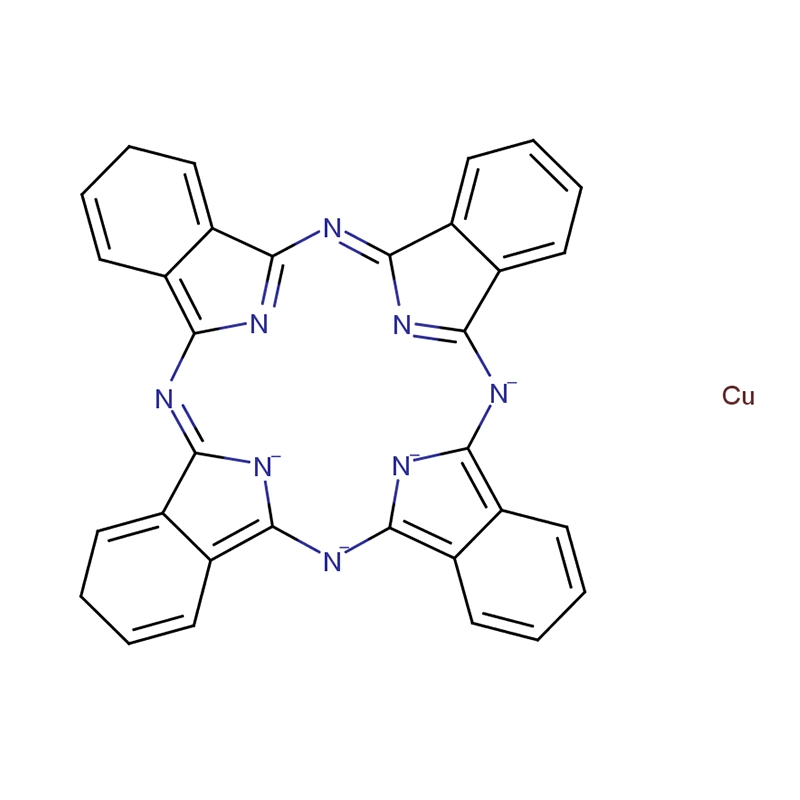
Product Description
Copper(II) phthalocyanine (CuPc) has been investigated as an electron-donor material in vacuum-deposited organic photovoltaic (OPV) devices, particularly in combination with fullerene-C60 or phenyl-C61-butyric acid methyl ester (PCBM). In specific device configurations, power conversion efficiencies (PCEs) of approximately 1% have been reported. Incorporating pentacene into the CuPc layer has also been shown to improve device performance, with reported PCEs reaching up to 4% under certain experimental conditions. These results highlight the potential of CuPc-based material systems for further optimization in organic solar cell research.
Product Parameters
| Melting point | 600°C (dec.) |
| Density | 1.62[at 20℃] |
| Storage temp | Inert atmosphere,Room Temperature |
| Solubility | insoluble in H2O, ethanol; soluble in concHSO 4 |
| Colour Index | 74160 |
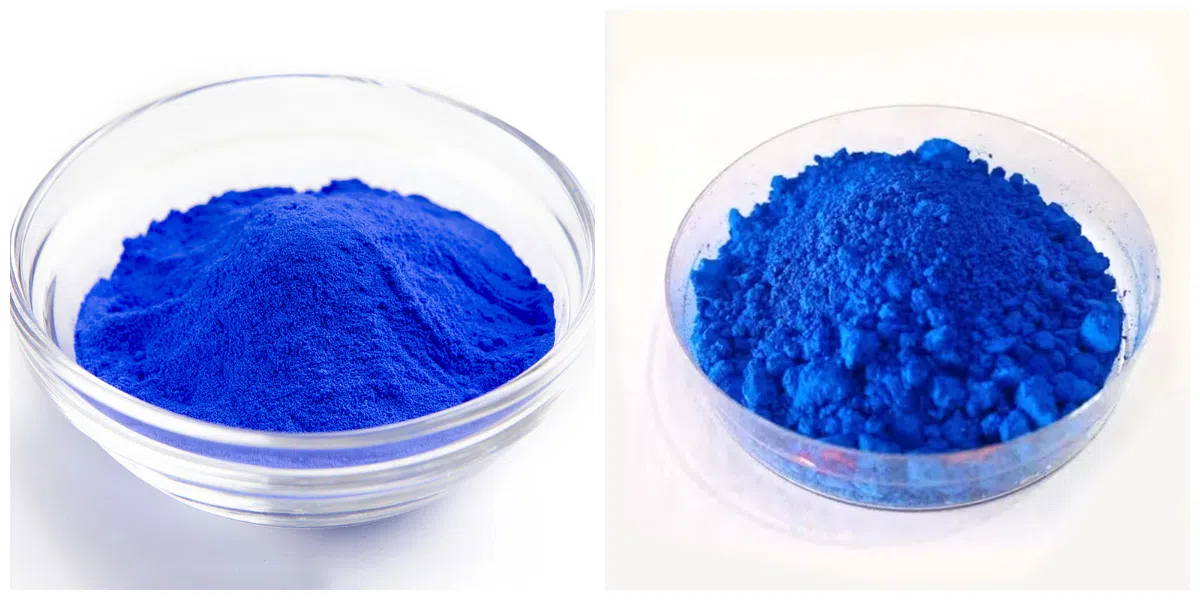
| Form | Fine Crystalline Powder |
| Color | Dark blue |
| Odor | odorless |
| Water Solubility | <0.1 g/100 mL at 20 ºC |
| λmax | 602nm(CHCl3)(lit.) |
| Hydrolytic Sensitivity | 4: no reaction with water under neutral conditions |
| Merck | 14,2520 |
| BRN | 4121848 |
| Exposure limits | ACGIH: TWA 1 mg/m3 NIOSH: IDLH 100 mg/m3; TWA 1 mg/m3 |
| InChIKey | XCJYREBRNVKWGJ-UHFFFAOYSA-N |
| LogP | -1 at 23℃ |
| NIST Chemistry Reference | Copper phthalocyanine(147-14-8) |
| EPA Substance Registry System | C.I. Pigment Blue 15 (147-14-8) |
| Absorption | λmax 678 nm (DMF) |
Safety Information
| Safety Statements | 22-24/25 |
| WGK Germany | - |
| RTECS | GL8510000 |
| TSCA | Yes |
| HS Code | 32041300 |
| Hazardous Substances Data | 147-14-8(Hazardous Substances Data) |
| Toxicity | LD50 intraperitoneal in rat: > 3gm/kg |
Application Scenarios
Copper(II) phthalocyanine (CuPc) is widely used as a high-performance blue pigment in coatings, printing inks, plastics, and rubber products. Its color properties and stability make it suitable for applications requiring consistent coloration and durable pigment performance.
In research and advanced materials development, CuPc is also studied for its semiconductor and photoactive properties, particularly in organic electronic devices such as organic photovoltaic (OPV) cells. Depending on the formulation and device design, it may be used in photoactive layers and other functional thin-film structures. CuPc and related phthalocyanine compounds are also investigated for applications in photochemistry, optical materials, and analytical research.