
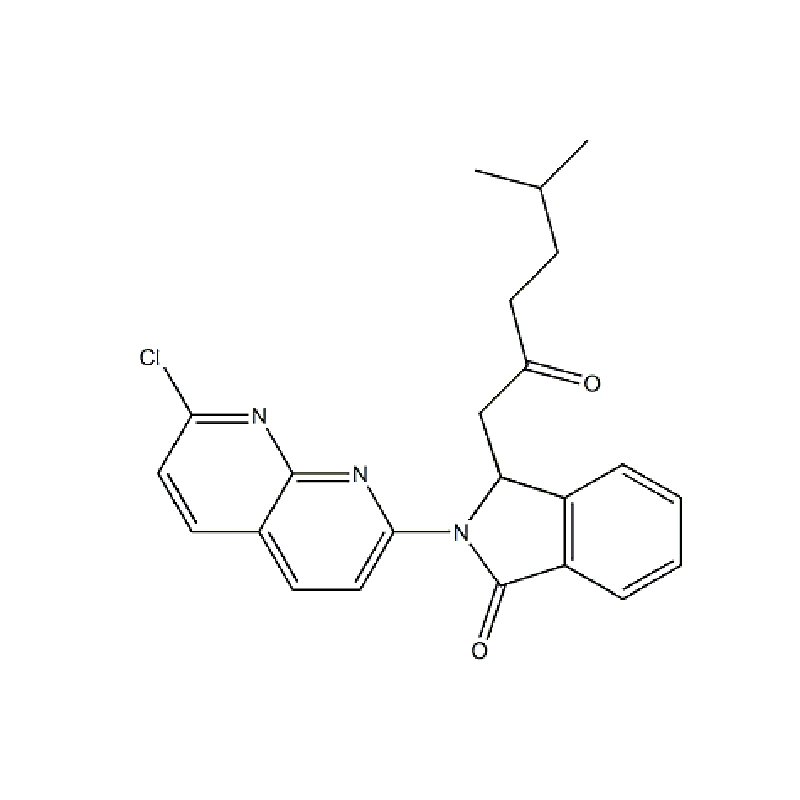
Product Description
Pagoclone is a cyclopyrrolone compound that has been investigated for its pharmacological activity at gamma-aminobutyric acid type A (GABA(A)) receptors. It acts as a partial agonist at these receptors, which play an important role in inhibitory neurotransmission in the central nervous system.
Pagoclone has been studied for its potential effects on persistent developmental stuttering and related neurological processes. Clinical investigations have explored its safety, tolerability, and potential efficacy; however, its therapeutic benefits have not been conclusively established, and it is not an approved treatment for stuttering.
Due to its pharmacological properties, Pagoclone may be of interest in neuroscience and pharmacological research focused on GABA(A) receptor modulation and central nervous system activity. Its use should be limited to appropriate research settings and comply with applicable regulations.

Product Parameters
| Boiling point | 582.1±50.0 °C(Predicted) |
| density | 1.273±0.06 g/cm3(Predicted) |
| pka | 1.62±0.30(Predicted) |
| InChI | InChI=1S/C23H22ClN3O2/c1-14(2)7-10-16(28)13-19-17-5-3-4-6-18(17)23(29)27(19)21-12-9-15-8-11-20(24)25-22(15)26-21/h3-6,8-9,11-12,14,19H,7,10,13H2,1-2H3 |
| InChIKey | HIUPRQPBWVEQJJ-UHFFFAOYSA-N |
| SMILES | C1(=O)C2=C(C=CC=C2)C(CC(=O)CCC(C)C)N1C1=CC=C2C(=N1)N=C(Cl)C=C2 |
Application Scenarios
Pagoclone is a cyclopyrrolone compound investigated for its activity at gamma-aminobutyric acid type A (GABA(A)) receptors. As a partial agonist at GABA(A) receptors, it has been studied for its potential effects on inhibitory neurotransmission in the central nervous system.
Pagoclone has also been investigated in clinical research for its potential to reduce symptoms of persistent developmental stuttering. However, its clinical efficacy has not been conclusively established, and it is not an approved treatment for stuttering. Its primary relevance is in pharmacological and neuroscience research focused on GABA(A) receptor modulation and related neurological processes.