Product Description
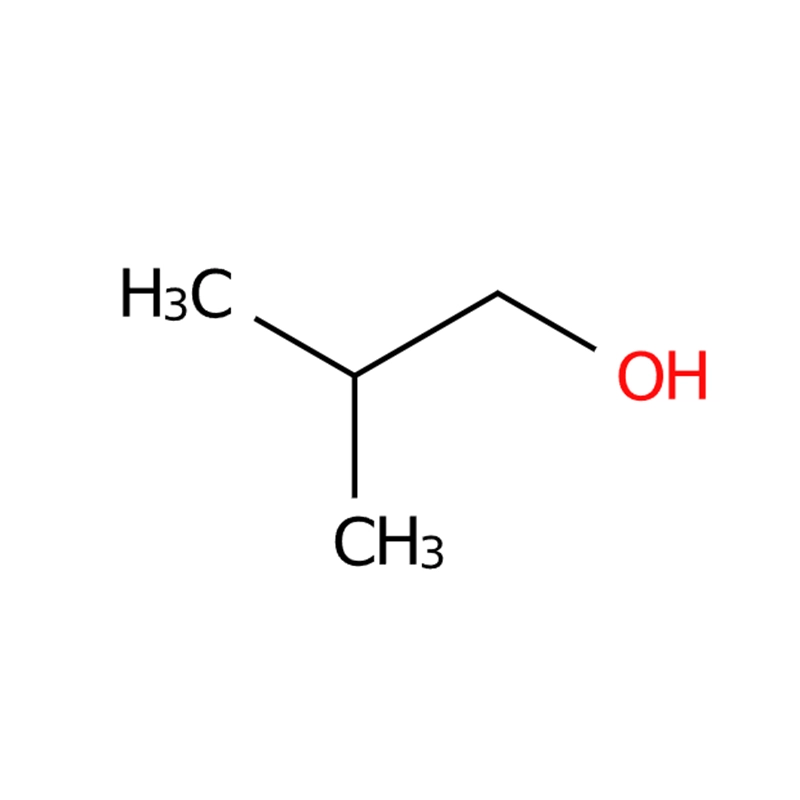
Isobutanol, also known as isobutyl alcohol or 2-methyl-1-propanol, is a colorless, flammable liquid with a characteristic alcohol odor. It occurs naturally in tea and other plant materials and can contribute to the aroma profile of fresh tea leaves, black tea, and green tea.
Isobutanol has a molecular weight of 74.12 g/mol, a boiling point of approximately 107.7°C, a relative density of about 0.802, and a refractive index of approximately 1.396. Its flash point is around 37°C.
It is readily soluble in alcohols and ethers but has limited solubility in water. Isobutanol is also flammable, and its vapor can form explosive mixtures with air under suitable conditions. Proper ventilation, fire protection, and safe handling procedures are therefore required.
Isobutanol can participate in various chemical reactions and may form molecular addition compounds with certain inorganic salts, including calcium chloride. It is widely used as a solvent, chemical intermediate, and raw material in coatings, resins, paints, pharmaceuticals, fragrances, and other chemical applications.
Product Parameters
| Melting point | 108 °C (lit.) |
| Boiling point | 108 °C (lit.) 108 °C |
| Density | 0.803 g/mL at 25 °C (lit.) |
| Vapor density | 2.55 (vs air) |
| Vapor pressure | 8 mm Hg ( 20 °C) |
| Refractive index | n20/D 1.396(lit.) |
| FEMA | 2179 | ISOBUTYL ALCOHOL |
| Fp | 82 °F |
| Storage temp | Store at +5°C to +30°C. |
| Solubility | water: miscible70g/L at 20°C; miscible with alcohol and oils. |
| Form | Solid |
| Pka | >14 (Schwarzenbach et al., 1993) |
| Color | APHA: ≤10 |
| Relative polarity | 0.552 |
| PH | 7 (80g/l, H2O, 20℃) |
| Odor | Slightly suffocating; nonresidual alcoholi |
| Odor Threshold | 0.011ppm |
| Explosive limit | 1.5-12%(V) |
| Odor Type | ethereal |
| Water Solubility | 95 g/L (20 ºC) |
| λmax | λ: 260 nm Amax: 0.10 λ: 280 nm Amax: 0.06 |
| JECFA Number | 251 |
| Merck | 14,5131 |
| BRN | 1730878 |
| Henry's Law Constant | 20.0 at 30.00 °C, 72.2 at 50.00 °C, 133 at 60.00 °C, 216 at 70.00 °C, 330 at 80.00 °C (headspace- GC, Hovorka et al., 2002) |
| Exposure limits | TWA 300 mg/m3 (100 ppm) NIOSH, 150 mg/m3 (50 ppm) (ACGIH); IDLH 8000 ppm. |
| Dielectric constant | 31.7(-80℃) |
| Stability | Stable. Flammable. Incompatible with strong oxidizing agents, aluminium. |
| InChIKey | ZXEKIIBDNHEJCQ-UHFFFAOYSA-N |
| LogP | 1 at 25℃ |
| CAS DataBase Reference | 78-83-1(CAS DataBase Reference) |
| NIST Chemistry Reference | 1-Propanol, 2-methyl-(78-83-1) |
| EPA Substance Registry System | Isobutanol (78-83-1) |
Safety Information
| Hazard Codes | Xi |
| Risk Statements | 10-37/38-41-67 |
| Safety Statements | 13-26-37/39-46-7/9 |
| RIDADR | UN 1212 3/PG 3 |
| OEB | A |
| OEL | TWA: 50 ppm (150 mg/m3) |
| WGK Germany | 1 |
| RTECS | NP9625000 |
| Autoignition Temperature | 801 °F |
| TSCA | Yes |
| HazardClass | 3 |
| PackingGroup | III |
| HS Code | 29051990 |
| Hazardous Substances Data | 78-83-1(Hazardous Substances Data) |
| Toxicity | LD50 orally in rats: 2.46 g/kg (Smyth) |
| IDLA | 1,600 ppm |
Application Scenarios
1. Analytical and Laboratory Applications: Used as an analytical reagent, chromatographic solvent, extraction solvent, and laboratory solvent.
2. Organic Synthesis: Serves as an important organic synthesis feedstock and industrial solvent for a variety of chemical processes.
3. Chemical Intermediate: Used in the production of isobutyronitrile and other intermediates for downstream chemical manufacturing.
4. Industrial and Chemical Applications: Used as a raw material or solvent in the production of fuel additives, antioxidants, plasticizers, synthetic rubber, fragrances, flavor compounds, coatings, and pharmaceutical intermediates. It can also be used in certain chemical separation and purification processes.
5. Food and Flavor Applications: Used as an extraction solvent and flavoring ingredient in applications permitted under applicable food regulations.