
Product Description
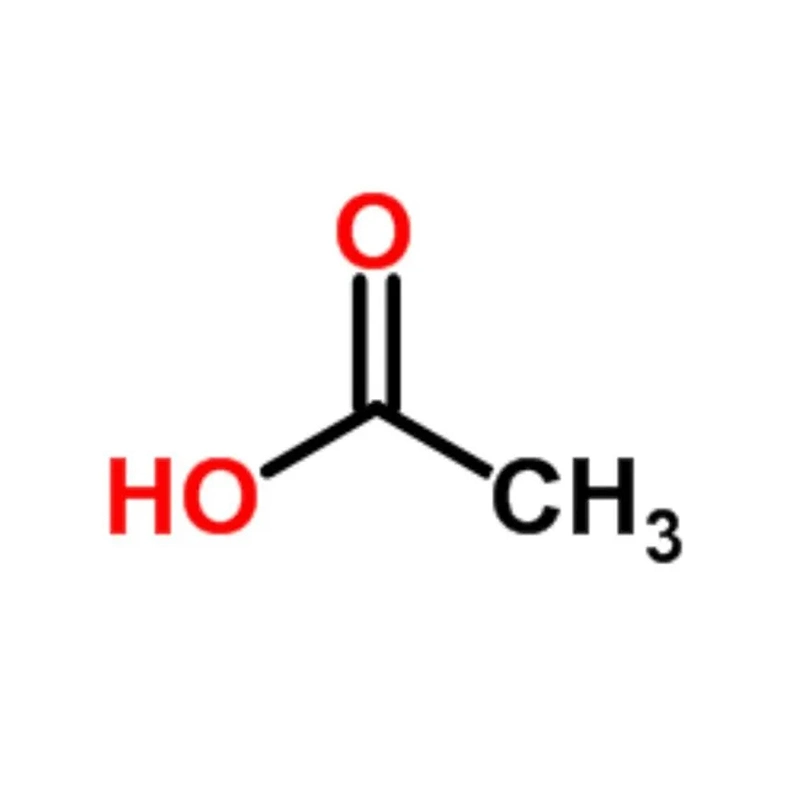
Acetic Acid (Ethanoic Acid, AcOH) is an important organic acid with the molecular formula CH₃COOH. It is the main acid component responsible for the characteristic sour taste and odor of vinegar and occurs naturally in many plants, either in its free form or as acetate esters.
Acetic acid is one of the most widely used organic acids and chemical feedstocks in the chemical industry. It is valued for its versatile chemical properties and is widely used in the production of vinyl acetate monomer (VAM), acetic anhydride, acetate esters, pharmaceuticals, coatings, textiles, and other chemical products.
Dilute acetic acid is commonly associated with vinegar, while high-purity concentrated acetic acid is commercially available as glacial acetic acid. Due to its broad range of chemical applications, acetic acid is an important raw material for numerous downstream manufacturing processes.
Product Parameters
| Melting point | 16.2 °C(lit.) |
| Boiling point | 117-118 °C(lit.) |
| density | 1.049 g/mL at 25 °C(lit.) |
| vapor density | 2.07 (vs air) |
| vapor pressure | 11.4 mm Hg ( 20 °C) |
| refractive index | n20/D 1.371(lit.) |
| FEMA | 2006 | ACETIC ACID |
| Fp | 104 °F |
| storage temp. | Store below +30°C. |
| solubility | alcohol: miscible(lit.) |
| form | Solution |
| pka | 4.74(at 25℃) |
| Specific Gravity | 1.0492 (20℃) |
| color | colorless |
| Odor | Strong, pungent, vinegar-like odor detectable at 0.2 to 1.0 ppm |
| PH | 3.91(1 mM solution);3.39(10 mM solution);2.88(100 mM solution); |
| PH Range | 2.4 (1.0M solution) |
| Odor Threshold | 0.006ppm |
| Odor Type | acidic |
| explosive limit | 4-19.9%(V) |
| Water Solubility | miscible |
| λmax | λ: 260 nm Amax: 0.05 λ: 270 nm Amax: 0.02 λ: 300 nm Amax: 0.01 λ: 500 nm Amax: 0.01 |
| Merck | 14,55 |
| JECFA Number | 81 |
| BRN | 506007 |
| Henry's Law Constant | 133, 122, 6.88, and 1.27 at pH values of 2.13, 3.52, 5.68, and 7.14, respectively (25 °C, Hakuta et al., 1977) |
| Dielectric constant | 4.1(2℃) |
| Exposure limits | TLV-TWA 10 ppm ~25 mg/m3) (ACGIH, OSHA, and MSHA); TLV-STEL 15 ppm (37.5 mg/m3) (ACGIH). |
| Stability: | Volatile |
| LogP | -0.170 |
| CAS DataBase Reference | 64-19-7(CAS DataBase Reference) |
| NIST Chemistry Reference | Acetic acid(64-19-7) |
| EPA Substance Registry System | Acetic acid (64-19-7) |
Safety Information
| Hazard Codes | C,Xi |
| Risk Statements | 34-42-35-10-36/38 |
| Safety Statements | 26-36/37/39-45-23-24/25 |
| RIDADR | UN 1792 8/PG 2 |
| WGK Germany | 3 |
| RTECS | NN1650000 |
| F | 1-8-10 |
| Autoignition Temperature | 426 °C |
| TSCA | Yes |
| HazardClass | 8 |
| PackingGroup | II |
| HS Code | 29152100 |
| Hazardous Substances Data | 64-19-7(Hazardous Substances Data) |
| Toxicity | LD50 in rats (g/kg): 3.53 orally (Smyth) |
| IDLA | 50 ppm |
Physical and Chemical Properties of Acetic Acid
Pure Acetic Acid is a clear, colorless liquid with a distinctive pungent odor. It has a melting point of approximately 16.6°C, a boiling point of about 117.9°C, and a relative density of approximately 1.049 at 20°C.
Acetic acid is completely miscible with water, ethanol, glycerol, and ether, and also dissolves in several other organic solvents. It is insoluble in carbon disulfide.
When acetic acid is highly concentrated or anhydrous, it can solidify into ice-like crystals below 16.6°C, which is why high-purity acetic acid is commonly known as glacial acetic acid.
Chemically, acetic acid is a weak organic acid with strong chemical versatility. It exhibits typical acid reactions and can readily undergo esterification with alcohols to produce acetate esters, which are widely used as solvents, chemical intermediates, and flavoring compounds.
Due to its acidity, concentrated acetic acid is corrosive and should be handled and stored according to appropriate industrial safety requirements.