Product Description
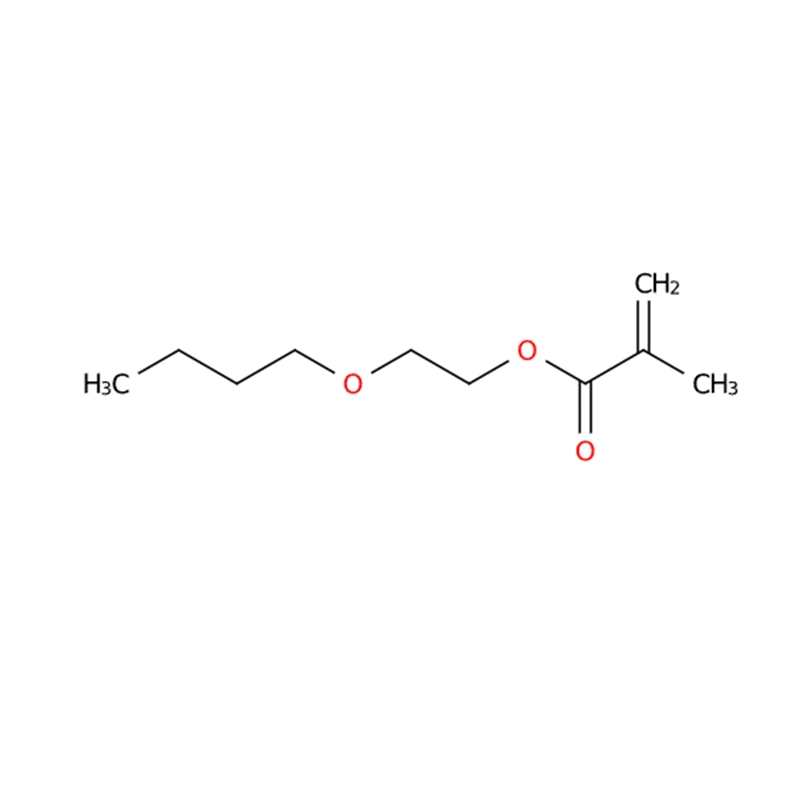
2-n-Butoxyethyl Methacrylate (BEM) is a specialty methacrylate monomer used in the formulation of polymer materials. Its molecular structure incorporates a butoxyethyl group, which can help tailor polymer flexibility, moisture resistance, and overall performance. BEM is suitable for various formulation systems, including protective coatings, industrial resins, and adhesives, where it can contribute to desired film properties and application performance.
Product Parameters
| English Name | 2-N-BUTOXYETHYL METHACRYLATE |
| English Synonyms | 2-Butoxyethylmethacrylate;2-Propenoicacid,2-methyl-,2-butoxyethylester;2-N-BUTOXYETHYL METHACRYL ATE;N-BUTOXY ETHYL METHACRYLATE;2-n-Butoxyethyl methacrylate 13532-94-0;Ethylene glycol butyl ether methacrylate;Methacrylic acid (3-oxaheptan-1-yl) ester;Methacrylic acid 2-butoxyethyl ester |
| CAS Number | 13532-94-0 |
| Molecular Formula | C10H1803 |
| Molecular Weight | 186.25 |
| EINECS Number | 236-885-7 |
| Melting point | 90~92℃/3mm |
| Boiling point | 90-92°C 3mm |
| Density | 0.939 g/mL at 25 °C(lit.) |
| Vapor pressure | 99Pa at 20℃ |
| Refractive index | n20/D 1.4335(lit.) |
| Flash point | 93℃ |
| Water solubility | 1.007g/L at 25℃ |
| InChI | InChI=1S/C10H1803/c1-4-5-6-12-7-8-13-10(11)9(2)3/h2,4-8H2,1,3H3 |
| InChIKey | DJKKWVGWYCKUFC-UHFFFAOYSA-N |
| Smiles | C(OCCOCCCC)(=O)C(C)=C |
| LogP | 2.47 at 25℃ |
Application Scenarios
2-n-Butoxyethyl Methacrylate (BEM) is a specialty methacrylate monomer used in polymer synthesis and material formulation. Its flexible butoxyethyl side chain makes it useful for modifying polymer properties, particularly flexibility and hydrophobicity. Key application areas include:
Industrial Coatings: Used in selected coating resin formulations to help tailor film flexibility, adhesion, and surface properties.
Adhesives and Sealants: Used as a comonomer in polymer systems designed to achieve specific flexibility and bonding characteristics.
Synthetic Resins: Applied in the synthesis of specialty methacrylate copolymers to adjust glass transition temperature (Tg) and other material properties.
Functional Polymer Materials: Used in the development of specialty polymer networks and advanced materials where flexibility and controlled polymer characteristics are required.