Product Description
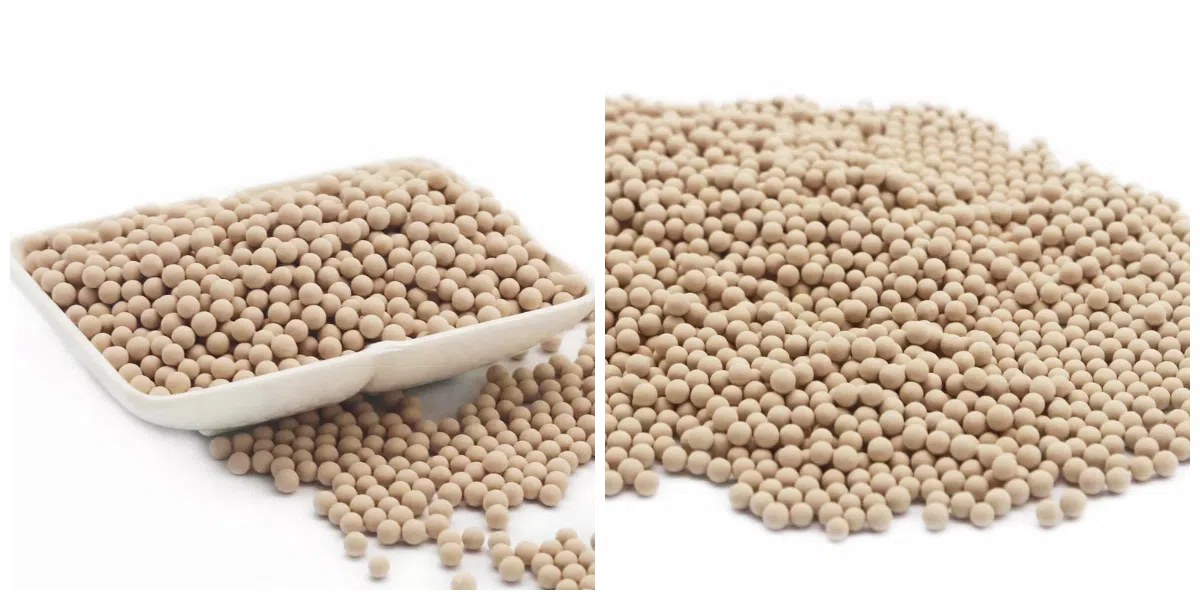
Zeolite is a broad family of crystalline aluminosilicate minerals characterized by a distinctive three-dimensional porous framework. It occurs naturally and can also be produced through synthetic processes to meet specific industrial requirements. To date, approximately 40 naturally occurring zeolite species and more than 150 synthetic varieties have been identified. Zeolite typically appears as a light gray powder or granular material, although its color may vary depending on its mineral composition and impurities, ranging from pale gray to reddish hues.
Physical Properties and Functional Characteristics of Zeolite
Zeolite is characterized by a relatively low bulk density, making it lighter than many conventional mineral materials. This distinctive property is attributed to its highly porous crystalline framework, which consists of an interconnected network of microscopic pores and channels. Similar to a honeycomb structure, this three-dimensional pore system provides a large internal surface area and enables excellent adsorption, molecular sieving, and ion-exchange performance. These properties make zeolite a versatile functional material widely used in water treatment, gas separation and purification, catalytic processes, and agricultural applications.
Product Parameters
| Melting point | >1600°C |
| Density | 1.9~2.3g/cm3 |
| Bulk density | 700-750kg/m3 |
| Storage temp. | no restrictions. |
| Form | powder |
| Pka | 10.348[at 20 ℃] |
| Color | White |
| PH | 8-11 (H2O) |
| Odor | wh., odorless powd. |
| biological source | mouse |
| Water Solubility | Insoluble in water. |
| Sensitive | Hygroscopic |
| Exposure limits | ACGIH: TWA 10 mg/m3 OSHA: TWA 15 mg/m3 NIOSH: IDLH 5000 mg/m3; TWA 2.4 mg/m3; TWA 0.3 mg/m3 |
| IARC | 3 (Vol. 68) 1997 |
| EPA Substance Registry System | Zeolites (1318-02-1) |
Safety Information
| Hazard Codes | Xn |
| Risk Statements | 36/37/38-36/37-20 |
| Safety Statements | 26-7/9-36-22 |
| WGK Germany | 3 |
| RTECS | ZG6800000 |
| F | 3 |
| HS Code | 2842 10 00 |
Application Scenarios
Zeolite is a versatile porous aluminosilicate material widely used in environmental protection, petrochemical processing, water treatment, gas purification, and agricultural applications. Its unique crystalline framework, high adsorption capacity, molecular sieving properties, and ion-exchange capabilities make it suitable for a broad range of industrial processes.
1. Water Treatment and Wastewater Purification
Zeolite is widely used as an ion-exchange and filtration medium in water treatment systems. It helps remove ammonium ions, certain heavy metal ions, and other contaminants from industrial wastewater and contaminated water. It is also used in water softening processes to reduce water hardness by exchanging calcium and magnesium ions.
2. Gas Separation and Purification
Owing to its uniform microporous structure and selective adsorption properties, zeolite is extensively used in gas dehydration, separation, and purification. It can selectively adsorb water vapor, carbon dioxide, and other gas components, making it suitable for natural gas processing, industrial gas purification, and pressure swing adsorption (PSA) systems.
3. Petrochemical Industry and Catalysis
Zeolite serves as an important solid acid catalyst and catalyst support in petroleum refining and petrochemical manufacturing. It is commonly applied in catalytic cracking, hydrocarbon isomerization, alkylation, and other chemical conversion processes, helping improve reaction selectivity, product quality, and process efficiency.
4. Detergent Manufacturing
Zeolite, particularly Zeolite 4A, is widely used as a phosphate-free builder in laundry detergent formulations. Through its ion-exchange properties, it removes calcium and magnesium ions from water, reducing water hardness and improving detergent cleaning performance.
5. Agriculture and Soil Improvement
Natural zeolite is used as a soil conditioner and functional fertilizer carrier in agricultural applications. Its porous structure helps improve soil water retention, retain nutrient ions, and regulate nutrient availability. It can also support soil conditioning and improve fertilizer utilization efficiency.
6. Environmental Protection and Odor Control
Zeolite is used in environmental remediation and odor-control applications due to its adsorption and ion-exchange properties. It can help capture ammonium ions and certain gaseous or dissolved contaminants, making it useful in landfill treatment, livestock facilities, wastewater management, and industrial air filtration.