
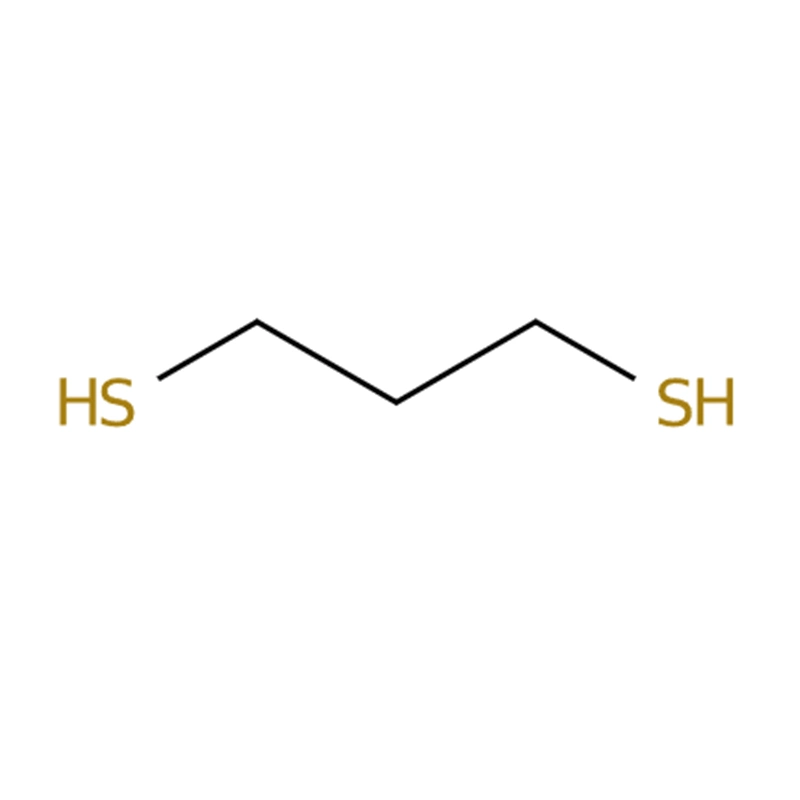
Product Description
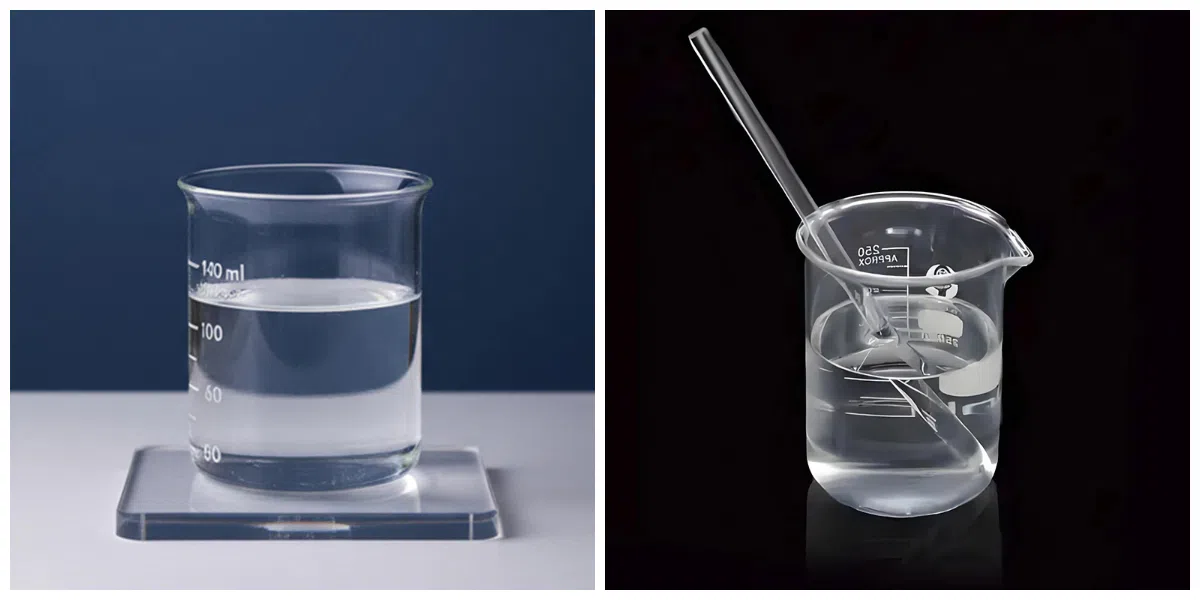
1,3-Dimercaptopropane is generally a colorless and transparent liquid at room temperature. Due to its susceptibility to oxidation and other environmental factors, it may gradually develop a slight yellowish coloration during prolonged storage.
Under normal temperature and atmospheric pressure conditions, 1,3-Dimercaptopropane remains in a liquid state and exhibits good fluidity. Its density is slightly higher than that of water, while its solubility in water is relatively low. It is, however, highly compatible with a variety of organic solvents and shows good miscibility with solvents such as ethanol, ether, benzene, chloroform, and other similar organic solvents.
Product Parameters
| Product Name: | 1,3-Dimercaptopropane |
| Synonyms: | 1,3-Propanedimercaptan;1,3-propyldimercaptan;NDR-132;FEMA 3588;DITHIOTRIMETHYLENEGLYCOL;1,3-DIMERCAPTOPROPANE;1,3-PROPANEDITHIOL;propane-1,3-dithiol |
| CAS: | 109-80-8 |
| MF: | C3H8S2 |
| MW: | 108.23 |
| EINECS: | 203-706-9 |
| Product Categories: | Building Blocks;Chemical Synthesis;Contact Printing;Dithiols;Materials Science;Micro/NanoElectronics;thiol Flavor;Organic Building Blocks;Self Assembly &;Self-Assembly Materials;Sulfur Compounds;Thiols;Thiols/Mercaptans |
| Mol File: | 109-80-8.mol |
| Melting point | -79 °C (lit.) |
| Boiling point | 169 °C (lit.) |
| density | 1.078 g/mL at 25 °C (lit.) |
| vapor density | >1 (vs air) |
| vapor pressure | 5 mm Hg ( 37.7 °C) |
| refractive index | n20/D 1.539(lit.) |
| FEMA | 3588 | 1,3-PROPANEDITHIOL |
| Fp | 138 °F |
| storage temp. | Store below +30°C. |
| form | Liquid |
| pka | 9.86±0.10(Predicted) |
| color | Clear light yellow |
| Specific Gravity | 1.078 |
| Odor | at 0.10 % in propylene glycol. meaty sulfurous |
| Odor Type | meaty |
| biological source | synthetic |
| Water Solubility | <0.1 g/100 mL at 21 ºC |
| JECFA Number | 535 |
| Merck | 147801 |
| BRN | 1071197 |
| Stability: | Stable. Incompatible with oxidizing agents, bases, reducing agents, alkali metals. Store cool. |
| LogP | 1.7 |
| CAS DataBase Reference | 109-80-8(CAS DataBase Reference) |
| NIST Chemistry Reference | 1,3-Propanedithiol(109-80-8) |
| EPA Substance Registry System | 1,3-Propanedithiol (109-80-8) |
Application Scenarios
As a commonly-used chemical reagent, 1,3-propanedithiol finds broad application in the preparation of thioketals and thioacetals. Apart from its function as a flavouring substance, it is also a key starting material employed to synthesize cyclic dithioacetal derivatives known as 1,3-dithianes using carbonyl-containing compounds.
Moreover, 1,3-propanedithiol is capable of reacting with triiron dodecacarbonyl to yield diiron propanedithiolate hexacarbonyl. Another frequent application lies in the protection of aldehydes and ketones: it forms reversible dithiane frameworks to realise this protective effect. Furthermore, it is able to bind with metal ions to form stable chelate rings. This property grants the compound important research value within coordination chemistry and its associated application fields.